

The post is about the decision in C-123/20 Ferrari SpA v Mansory Design & Holding GmbH and WH, issued on 28 October 2021 by the Court of Justice of the European Union (CJEU). The Federal Court of Justice in Germany sought guidance from the CJEU in a design dispute between luxury car maker Ferrari and German car design company Mansory Design over elements of the Ferrari FXX K model’s bodywork.
The bodywork in dispute was the V-shaped section of the bonnet and the front bumper. Ferrari asserted this feature distinguishes the Ferrari FXX-K from other cars (including other Ferrari models).
Ferrari had commenced proceedings in Germany against Mansory Design for manufacturing and selling these bodywork additions which were designed to make the Ferrari 488 GTB, which is priced at around $250,000, look like the Ferrari FXX K, which is priced at $2.6 million. Ferrari asserted that Mansory Design infringed its rights to the unregistered designs.
The issue started with a press release issued by Ferrari on 2 December 2014, detailing the overall appearance of the Ferrari FXX K, and which included the below images within the press release.
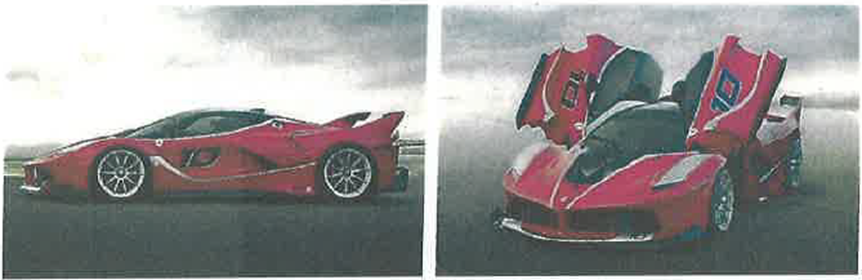
The date of the press release was a critical issue of fact, given unregistered Community designs are calculated from the date on which they are first made available to the public within the European Union.
Mansory Design then started distributing ‘tuning’ kits. These were entirely intended to transform the appearance of the Ferrari 448 GTB.
And in March 2016, at the International Motor Show in Geneva (Switzerland), Mansory Design displayed a vehicle featuring that conversion under the name Mansory Siracusa 4XX.
The questions asked by the Federal Court of Justice of the CJEU were:
Can unregistered Community designs in individual parts of a product arise as a result of disclosure of an overall image of a product in accordance with Article 11(1) and the first sentence of Article 11(2) of Regulation No 6/2002?
and
If Question 1 is answered in the affirmative:
What legal criterion is to be applied for the purpose of assessing individual character in accordance with Article 4(2)(b) and Article 6(1) of Regulation [No 6/2002] when determining the overall impression of a component part which – as in the case of a part of a vehicle’s bodywork, for example – is to be incorporated into a complex product? In particular, can the criterion be whether the appearance of the component part, as viewed by an informed user, is not completely lost in the appearance of the complex product, but rather displays a certain autonomy and consistency of form such that it is possible to identify an aesthetic overall impression which is independent of the overall form?’
The CJEU found that a component of an overall design can be considered to be an individual part with its own design rights if it is “a visible section of the product or complex product, clearly defined by particular lines, contours, colours, shapes or texture”. The CJEU concluded:
“…the answer to the questions referred is that Article 11(2) of Regulation No 6/2002 must be interpreted as meaning that the making available to the public of images of a product, such as the publication of photographs of a car, entails the making available to the public of a design of a part of that product, within the meaning of Article 3(a) of that regulation, or of a component part of that product, as a complex product, within the meaning of Article 3(c) and Article 4(2) of that regulation, provided that the appearance of that part or component part is clearly identifiable at the time the design is made available. In order for it to be possible to examine whether that appearance satisfies the condition of individual character referred to in Article 6(1) of that regulation, it is necessary that the part or component part in question constitute a visible section of the product or complex product, clearly defined by particular lines, contours, colours, shapes or texture.”
It is worth noting that Ferrari lost at first instance before the Landgericht Düsseldorf (Regional Court, Düsseldorf, Germany) and lost again on appeal to the Oberlandesgericht Düsseldorf (Higher Regional Court, Düsseldorf, Germany). Ferrari’s persistence paid off.
But through the passage of time, Mansory Design is now able to go ahead with the sale of the tuning kits: the duration of the protection afforded to holders of unregistered Community designs is limited to three years as from the date on which the design was first made available to the public, which in this instance concluded on 3 December 2017. I assume the litigation is strategic, creating Ferrari (and, incidentally, other luxury vehicle manufacturers) a three-year buffer – a sort of first-mover advantage – over aspects of bodywork designs, where “the design claimed consists of a component part of a complex product”. It does not seem long enough, given the effort and expense which goes into the design and testing of bodywork components.