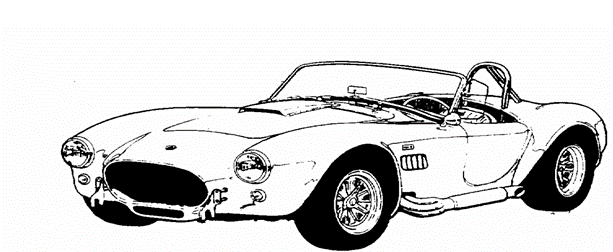
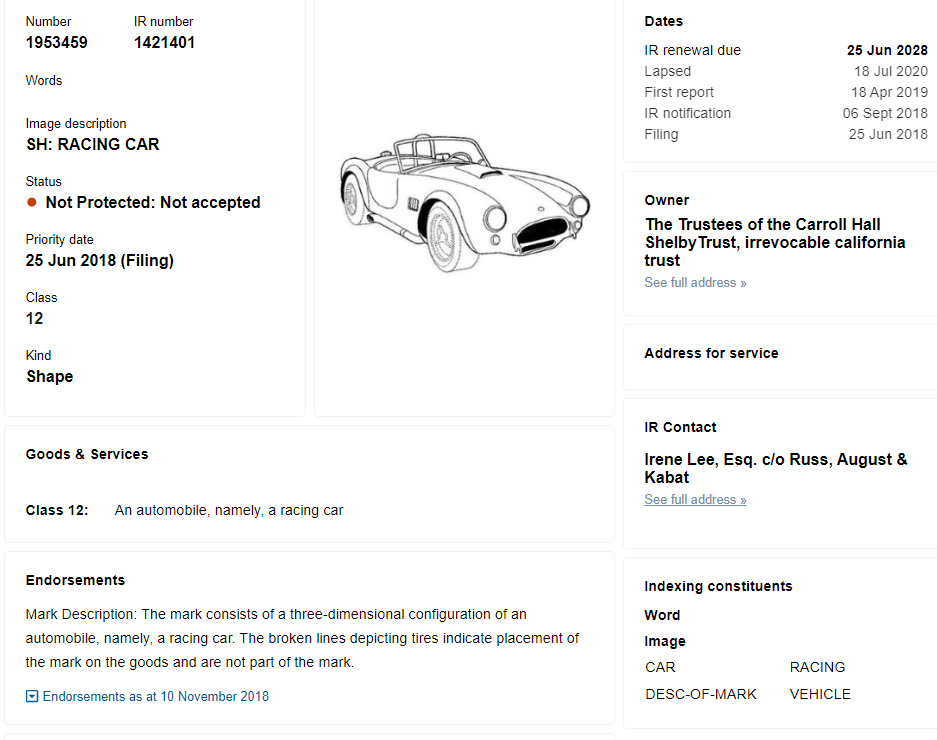
On 25 June 2018, legendary car maker Carroll Shelby filed an Australian trade mark application for the classic Cobra 427 S/C design. It encountered an adverse report from the examiner on 18 April 2019, and lapsed. Here is an extract from the Australian register:
Mr Shelby has had ongoing issues with the protection of this car design. Back in 1995 Mr Shelby applied to register the same car design as a US trade mark, claiming use dating back to 1965. Here is an extract from the US Patent and Trademark Office’s records (Application Serial No. 75586777):
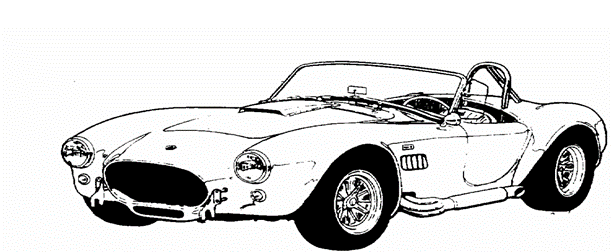
The application was opposed (Opposition No. 91150346) in 1998, and (eventually) was determined at a Trademark Trial and Appeal Board hearing in 2010. The opposer was Factory Five Inc, a manufacturer of replica vehicles.
The TTAB set out the background:
“Carroll Shelby is a highly recognized designer of cars, in particular, high performance sports cars. Beginning in the early 1960s, Mr. Shelby joined with Ford Motor Company to design and produce a series of high performance sports cars identified as Cobras. Mr. Shelby achieved some success and additional notoriety in racing those cars. In 1965 Shelby introduced the Cobra 427 S/C, one of the cars in that series. Ford and Shelby ceased the production of the original Cobras, including the 427 S/C, in 1968. After Ford and Shelby ceased production of the original Cobras, numerous third parties began to produce replicas of Cobras, principally in kit form, including the Cobra 427 S/C. … The original Cobras, including the Cobra 427 S/C, have received a high degree of recognition among sport and race car enthusiasts since they were first built. Collectors value the original Cobras highly and purchase them through sales and auctions. One of the most valued original Cobras, one owned by Mr. Shelby, was sold at auction for $5.5 million.”
What did the TTAB say?
“… The fact that unauthorized replicas were being sold is well known in the industry.… A Shelby website states that, “The Cobra became the most replicated design in automotive history with literally hundreds of companies capitalizing on the popularity of the design.”… the apparent ongoing prevalence of unauthorized third-party sales of Cobra replicas, including Cobra 427 S/Cs, has an obvious impact on applicant’s ability to show acquired distinctiveness. This circumstance raises serious doubt as to whether applicant’s use of the Cobra 427 S/C Design is substantially exclusive. Both the length of time and extent of the unauthorized sales is not something we can dismiss as insignificant.”
Evidence of use provided by continuations was, with respect, glossed over:
In 1992, Shelby began to produce “continuations” or
replicas of the original Cobras, including the Cobra 427
S/C, primarily in kit form. Shelby 2001 at 88-89; Shelby
2009 at 9. A kit typically includes a chassis and body,
but the purchaser is then required to assemble and complete
the car with a transmission and engine and possibly other
parts. Mr. Shelby identified the replicas of the Cobra 427
S/C with the designation CSX 4000. Shelby 2009 at 55.
Shelby has sold the Cobra replica kits for $50,000 to
$150,000. Shelby 2001 at 88-89. Between 2002 and 2009,
Shelby, and its licensees, produced between 100-300 Cobras
per year, including an unspecified number of Cobra 427 S/Cs
continuations or replicas. Shelby 2009 at 9, 16 and 78-79.
As of the date of Mr. Shelby’s 2009 testimony, only one
company, Superformance Intl. Inc., was producing the Cobra
replicas under license from Shelby.
It is one thing to recognize the legendary status of
Mr. Shelby and the original Cobras, including the 427 S/C,
and quite another to assert that purchasers and potential
purchasers view Cobra continuations or replicas, sold
primarily as kits, which employ the Cobra 427 S/C Design as
coming from a single source.
This was an argument, fundamentally, about acquired distinctiveness. It evolves there were not many Cobra 427 S/C models sold – adding to the mystique of the marque, I think, but, surprisingly, they were sold inexpensively. The TTAB noted,
“In the period from 2002 to 2009, applicant’s
sale of all Cobras is generally small, 100 to 300.“
Looking at sales figures seems unfair. The cars are a niche product, not a fast-moving consumer good.
The applicant argued that the media attention generated by the vehicles created acquired distinctiveness – also dismissed by the TTAB as a weak argument. Again, I query this. The shape of the cars is extremely well-known within what I’d think are relevant niche markets. Even the TTAB notes this:
The potential purchasers of the Cobra 427 S/C
continuation or replica kits, or similar kits, are, by
definition, a rather sophisticated group of people.
It seems to me that the application was doomed by suboptimal evidence, and the sheer extent of the counterfeiting. The number of companies producing unauthorised replicas was in the hundreds.