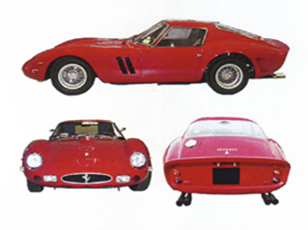
In this post, I look at Ares Performance AG v Ferrari SpA (EUIPO Cancellation Division No C 30 743: May 29, 2020). Ferrari suffered a significant (but, to be fair, not unexpected) loss when its trade mark registration for its famous 250 GTO car design was partially cancelled, except in so far as it related to toys. This is the image as it appeared in the trade mark registration:
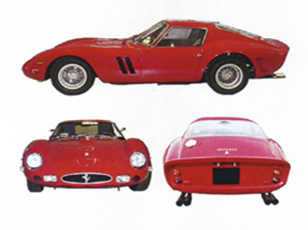
Ares Performance argued that the registration had not been in used for five years and should be removed. As Ares stated in its cancellation filing,
“…with regard to the goods listed [the 250 GTO design], the EUTM was in use in a similar form only for a few years, namely in the 1960s. It is similar to Ferrari’s 250 GTO model, which was created in 1962, with a relatively small production run of 36 cars.”
Ferrari argued that:
“…the 250 GTO model is a sports car produced from 1962 until 1964 only in 39 units, all still existing, and that it is recognised as one of the most glorious and iconic Ferrari cars ever created. Although no longer in production, the 250 GTO is still in great demand… Ferrari’s 250 GTO is destined to a very restricted market of collectors, celebrities and super-rich who can afford to spend millions of Euros to buy such an extra-expensive luxury car. This means that, at least as Class 12 is concerned, it will be sufficient to show very few sales of the products, of their spare parts, or of the related activities of maintenance, repair and restoration, to fulfill the use requirement.”
Genuine Use
But Ferrari’s evidence was ephemeral. Ferrari was unable to provide evidence of use of the mark on the invoices relating to class 12 goods – the references in that evidence were to Ferrari and Ferrari’s badge, not to the shape of the vehicle (not surprisingly, given the evidence consisted of invoices and not something like a sales brochure which would have demonstrated use of the shape).
Accordingly, the European Union Intellectual Property Office awarded Ares a partial victory, removing the 250 GTO shape registration for class 12 (vehicles and their assorted components), as well as for class 25 (clothing and related merchandise) and class 28 (games and playthings, except toy vehicles and scale-model vehicles) uses. Ferrari maintains the 250 GTO trade mark solely for scale models and toys, the only type of goods for which it could demonstrate use.
The decision hinged on the EU Intellectual Property Office’s Article 58(1)(a), which states trade marks that go effectively unused for a period of five years or more can be revoked. There must be “genuine use” to resist a revocation action, which means the company needs to actually build and sell cars shaped like the shape mark every five years or so. For a car manufacturer, that’s an onerous task.
Heritage reputation
Ferrari’s insistence during the proceedings that the shape is part of the company’s mystique was cast aside by the EU Intellectual Property Office. The position in Australia is different. Here, we have CUB Pty Ltd v Elixir Signature Pty Ltd [2013] ATMO 74 (10 September 2013). This decision from the Australian trade marks registrar is to do with beer, not cars, but applies to all heritage brands. Back in 2013, boutique brewer Thunder Road Brewing (the trading name of Elixir Signature) endeavoured to remove on the basis of non-use no less than 54 Australian beer brands owned by brewing giant Fosters (the trading name of CUB). Some of these brands are very old: Ballarat Brewing Company was established in 1910, after the amalgamation of three breweries, Royal Standard Brewery, Phoenix Brewery and Barley Sheaf Brewery, each established in 1857. Of other brands which were attacked on the basis of non-use, Fosters noted in its written submissions,
“CASCADE dates from 1832. TOOTH’S and KENT date from 1835, BALLARAT from 1853 and VICTORIA from 1854. McCRACKEN’S dates from 1851, CARLTON from 1864 and BULIMBA from 1882. The turn of the century saw ABBOTS emerge together with MELBOURNE in 1904, CAIRNS followed in 1925, then RICHMOND in 1927.”
Fosters argued during the hearing that Thunder Road Brewing were engaging in activity akin to ‘‘reaping what they haven’t sown’’ and represented a ‘‘commandeering’’ of Foster’s trade mark beer brands. Significantly, in Australia, the Registrar has the discretion to allow a trade mark to remain on the Register even if the grounds on which the removal application was made have been established. The discretion may be exercised if the Registrar is satisfied that it is reasonable to do so. The discretion is unlimited.
Thunder Road argued that Fosters were “banking” these old marks. It had an interesting argument:
“..;.far from protecting its heritage, CUB is acting as a roadblock to the freedom of other Australian companies from using historical trade marks. Without being able to brew and market these old brewery trade marks, the true story of Australian brewing cannot be told.”
(Written legal submissions in Australia in trade mark disputes usually have less flair.)
The Registrar didn’t give this argument credit, noting:
[Thunder Road] has almost 100 trade marks in class 32, either Registered or pending, including trade marks which are substantially identical with or deceptively similar to many of the CUB trade marks which Elixir wishes to remove from the Register.[31] This is a significant ‘bank’ of trade marks for a single relatively newly-formed commercial entity to hold and I note in passing that it appears to contradict Elixir’s stated attitude to the concept of the ‘banking’ of trade marks.
What was the result? In brief, the marks with strong residual reputation were allowed to stay on the register. The marks with no residual reputation were removed.
If Ares Performance v Ferrari SpA had played out in Australia, then, I think Ferrari would have won.
Continuation models and evergreening
One practical path around this is the production of continuation models. But, in the United States, even that didn’t help Shelby much (to be discussed in tomorrow’s post): in 1992, Shelby had produced continuations of the original models, although there the shape had been so solidly copied it was lucky not to have been found to be generic. And while continuation models are both very popular, and addresses issues such as modern safety or emission standards which might prevent the classic vehicles from being capable of registration to drive in some jurisdictions, their production erodes the mystique of exclusivity of the original vintage model.
The other strategy is evergreening a shape mark for a classic vehicle – repeatedly filing applications so as to defeat non-use removal applications. But such applications would likely be regarded as bad faith applications in at least some jurisdictions.
As for Ferrari itself, it has sort-of-but-not-quite avoided the continuation strategy, as noted recently in the Australian Financial Review https://www.afr.com/life-and-luxury/cars-bikes-and-boats/if-you-really-want-to-stand-out-buy-a-continuation-car-20220406-p5ab67 :
“Ferrari is producing a series of limited-edition cars known as Icona. These are modern vehicles which pay homage to past models without copying them. The latest is the Ferrari Daytona SP3, which gives a solid nod to sports-prototype racers of the 1960s, such as the Ferrari P3, P4 and 412P.”
No doubt Ferrari hopes that is enough to resist future non-use removal applications over its shape mark registrations for classic vehicles.